Why Filtration Matters in Pharmaceutical Quality Control
In pharmaceutical manufacturing, Quality isn't merely about regulations; it is about patient safety. All our raw materials, in-process, and finished goods go through various Quality Control (QC) testing before being introduced in the market. However, there is one of the most important and often neglected aspects of pharmaceutical analysis that plays a vital role: filtration. It plays a crucial role in ensuring that your analytical test results are reliable and accurate because:
- It removes particulates: Eliminates suspended solids that can interfere with analytical readings.
- It protects sensitive instruments: Prevents damage and clogs in expensive chromatography systems.
- It ensures sterility: Essential for preventing microbial contamination in sterile drug products.
- It enhances sample integrity: Ensures the sample analyzed is representative and uncontaminated.
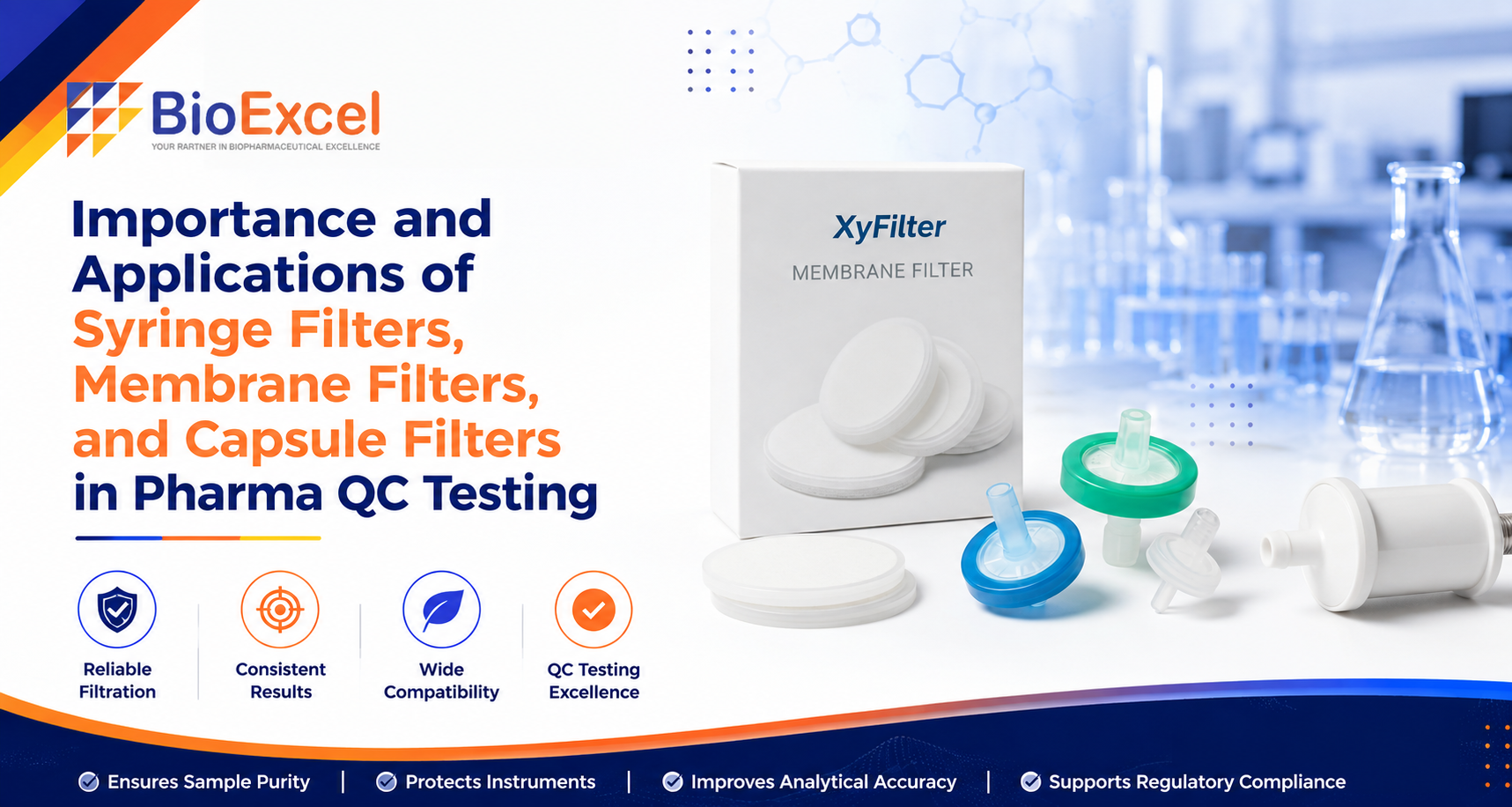
At BioExcel Pharma, we offer superior quality laboratory filtration products for high-standard quality control in pharmaceutical labs. Some of the commonly used filters are syringe filters, membrane filters, and capsule filters. Although all three products have one primary goal, which is to filter liquid samples, they differ in their usage depending upon the volume and application.
In analysis by HPLC, GC, UV, dissolution, microbiology, or sterility, filtering the sample is often the necessary step for proper sample preparation prior to analysis. Microscopic particles can adversely affect an analytical test result, damage fragile lab instruments, or contribute to sample contamination.
Effective laboratory filtration helps:
- Remove suspended particles and contaminants
- Improve accuracy and reproducibility of analytical testing
- Protect expensive chromatography columns and instruments
- Support sterility during pharmaceutical testing
- Meet GMP and regulatory compliance requirements
- Ensure reliable pharmaceutical quality control testing
Selecting the right filtration device is therefore critical for maintaining consistent and dependable laboratory results.
Syringe Filters – Ideal for Small Volume Sample Preparation
Syringe filters are among the most commonly used disposable filtration devices in pharmaceutical laboratories. They are attached directly to a syringe, allowing analysts to quickly filter small sample volumes before instrumental analysis.
Typical Applications
- HPLC sample preparation
- GC sample filtration
- Dissolution testing
- Buffer and reagent filtration
- Removal of particulate contaminants
Syringe filters are available with various membrane materials including PTFE, PES, Nylon, PVDF, and Cellulose Acetate, allowing compatibility with aqueous, organic, and mixed solvent samples. You can learn more about our specific syringe filter offerings, such as the Polyethersulfone (PES) Syringe Filter, PTFE Syringe Filter, Nylon Syringe Filter, and PVDF Syringe Filter.
Advantages
- Fast and convenient filtration
- Minimal sample loss
- Disposable and contamination-free
- Available in sterile and non-sterile options
- Suitable for sample volumes up to approximately 100 mL
For pharmaceutical QC laboratories performing routine analytical testing, syringe filters provide a reliable and efficient solution for sample clarification.
Membrane Filters – Precision Filtration for Analytical and Microbiological Testing
Membrane filters consist of thin porous membranes designed for highly precise particle retention. They are widely used where consistent pore size and analytical accuracy are required.
Common Applications
- Microbiological testing
- Sterility testing
- Water quality analysis
- Particulate analysis
- Pharmaceutical sample filtration
- Environmental monitoring
Available in pore sizes such as 0.22 µm and 0.45 µm, membrane filters help retain microorganisms and fine particulates while allowing liquids to pass through efficiently.
Key Benefits
- High filtration accuracy
- Excellent chemical compatibility
- Supports sterility assurance
- Suitable for laboratory validation procedures
- Compatible with filtration assemblies and vacuum manifolds
Membrane filters are an essential component in pharmaceutical laboratories where regulatory compliance and microbial testing are critical.
Capsule Filters – Efficient Filtration for Larger Sample Volumes
When larger volumes require filtration, capsule filters provide an ideal solution. These self-contained filtration units are designed for high flow rates while maintaining excellent filtration efficiency.
Typical Applications
- Bulk solution filtration
- Media preparation
- Buffer filtration
- Process validation
- Pilot-scale pharmaceutical manufacturing
- Biopharmaceutical processing
Unlike syringe filters, capsule filters can handle significantly larger sample volumes with reduced operator effort. For larger systems, options such as the PES Capsule Filters, PTFE Capsule Filters, and PVDF Capsule Filter are widely deployed.
Advantages
- High dirt-holding capacity
- Excellent flow characteristics
- Available in sterile and non-sterile configurations
- Reduced filtration time
- Suitable for laboratory and production environments
Capsule filters are particularly valuable when pharmaceutical QC workflows require filtration of hundreds of milliliters or even several liters of solution.
Syringe Filters vs. Membrane Filters vs. Capsule Filters
Choosing the right filtration format depends on sample volume, application, membrane compatibility, and sterility requirements.
| Feature | Syringe Filters | Membrane Filters | Capsule Filters |
|---|---|---|---|
| Filtration Scale | Small-volume laboratory samples | Analytical & microbiological testing | Medium to large-volume filtration |
| Sample Volume | Up to 100 mL | Depends on filter holder | 100 mL to several liters |
| Common Applications | HPLC, GC, dissolution testing | Sterility testing, microbial analysis | Buffer, media, bulk solution filtration |
| Membrane Compatibility | PTFE, PES, Nylon, PVDF, CA | Multiple membrane materials | Multiple membrane materials |
| Sterile Options | Yes | Yes | Yes |
| Non-Sterile Options | Yes | Yes | Yes |
| Ease of Use | Very High | Moderate | High |
| Best For | Routine sample preparation | Precision analytical testing | High-volume pharmaceutical filtration |
How to Select the Right Filtration Solution
The right filtration product depends on your laboratory application:
- Choose Syringe Filters for routine sample preparation before HPLC or GC analysis.
- Select Membrane Filters when sterility testing, microbial analysis, or precise particulate removal is required.
- Use Capsule Filters for filtering larger sample volumes, process solutions, buffers, or media efficiently.
Understanding these differences helps pharmaceutical laboratories improve workflow efficiency while maintaining analytical accuracy and regulatory compliance.
Conclusion
Reliable filtration is fundamental to pharmaceutical quality control. Whether preparing analytical samples, performing microbial testing, or filtering bulk process solutions, selecting the appropriate filtration device directly impacts testing accuracy, laboratory productivity, and product quality.
BioExcel Pharma offers a comprehensive range of Syringe Filters, Membrane Filters, and Capsule Filters engineered to meet the stringent demands of modern pharmaceutical laboratories. With high-quality membrane options, sterile and non-sterile configurations, and dependable performance, our filtration solutions support accurate pharmaceutical testing and consistent regulatory compliance.