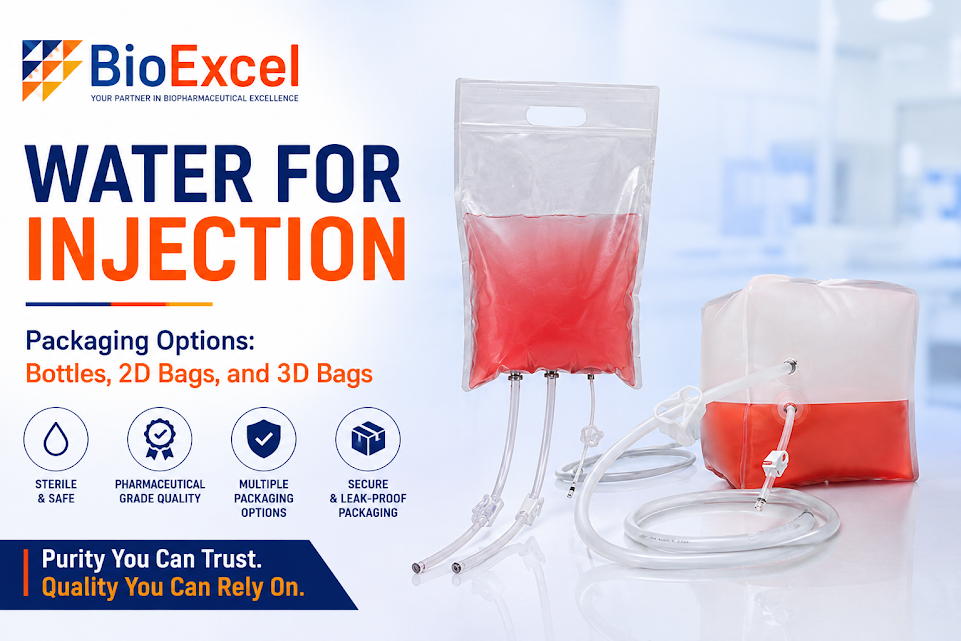
Water for injection (WFI) is perhaps the most vital process utility in the pharmaceutical and biopharmaceutical industries. The quality of this water affects the safety and reliability of the process as well as the contamination prevention of the products. Producing high-quality WFI alone is not enough; what is more important is the proper selection of WFI packaging.
Requirements differ from facility to facility. For example, the laboratory will be more comfortable with smaller bottles of water for injection (WFI), whereas the manufacturing process might require WFI carboys and/or large-sized single-use bags. 2D and 3D bioprocess bags could be beneficial in bioprocessing. Understanding these formats makes it easier to select packaging that matches the application.
WFI Bottles: Convenient for Small-Volume Requirements
WFI bottles are generally preferred when relatively small quantities of Water for Injection are required. They are practical for laboratory activities, formulation work, sampling, testing, and other applications where water is consumed in manageable volumes.
Their compact format makes them easy to store and handle. Bottles can also be convenient where operators need quick access to WFI without setting up a larger transfer system.
However, bottles become less practical as volume requirements increase. Handling multiple containers can increase packaging waste, storage requirements, and manual intervention. For frequent or high-volume operations, larger packaging formats may provide better operational efficiency.
WFI Carboys: A Practical Step Up in Volume
WFI carboys provide greater capacity than conventional bottles while maintaining relatively straightforward handling. They can be suitable for laboratories, cleanrooms, compounding areas, and manufacturing environments where moderate quantities of WFI are required.
Carboys reduce the number of individual containers needed and can simplify short-term storage and dispensing. Their rigid construction also provides predictable handling during movement.
The trade-off is space and weight. Larger rigid containers require dedicated storage and can become cumbersome when operators need to move significant volumes manually. For facilities looking to minimize manual handling or packaging footprint, flexible bag systems can offer an alternative.
2D Bags: Flexible Packaging for Controlled Environments
2D bioprocess bags are flexible, single-use containers designed with a two-dimensional configuration. They are increasingly used in biopharmaceutical processes where controlled fluid handling, reduced cross-contamination risk, and efficient use of space are important.
A major advantage of 2D bags for WFI is their flexibility. When empty, they occupy considerably less storage space than rigid containers. During use, they can support convenient fluid transfer through compatible tubing, connectors, and ports.
These bags are particularly useful for bioprocess applications, formulation, buffer preparation, media preparation, and other fluid-handling operations where single-use systems are preferred.
3D Bags: Designed for Larger-Volume Applications
3D bioprocess bags are engineered to expand in multiple dimensions, allowing them to accommodate larger fluid volumes while maintaining a flexible format. They are often considered when manufacturing processes require higher-volume fluid storage or transfer.
Compared with rigid containers, 3D bags can offer efficient space utilization and easier integration into single-use fluid management systems. Their configuration can also support controlled transfer and connection to process equipment.
For larger-scale biopharmaceutical operations, 3D bags may be preferred when flexibility, volume capacity, and streamlined fluid transfer are key considerations.
Comparing WFI Packaging Options
The right format depends on the application:
- Bottles: Best for small-volume use, laboratory activities, sampling, and convenient point-of-use handling.
- Carboys: Suitable for moderate volumes where rigid containers and straightforward storage are preferred.
- 2D bags: Well suited to flexible storage, cleanroom use, and single-use bioprocess applications.
- 3D bags: Preferred for larger volumes, process fluid storage, and demanding biopharmaceutical transfer requirements.
When selecting WFI packaging options, manufacturers should consider more than container size. Volume, storage footprint, cleanroom requirements, operator handling, transfer connections, process compatibility, and disposal requirements all influence the final choice.
Selection Matrix: Key Considerations at a Glance
Whether configuring analytical laboratories or multi-thousand liter bioproduction suites, matching the containment vessel to your fluid transfer closed-system requirements ensures maximum batch integrity, regulatory compliance (USP <1231> / EP), and lowest total cost of operation.
Frequently Asked Questions (FAQs)
Conclusion
Choosing the appropriate packaging of Water for Injection (WFI) may not only help increase handling efficiency but also facilitate contamination control strategies. Bottles, carboys, 2D bags, and even 3D bioprocess bags have their purposes and applications. If you need to find out more about WFI bottles, WFI carboys, 2D bags, and 3D bioprocess bags, feel free to contact our company – BioExcel Pharma.