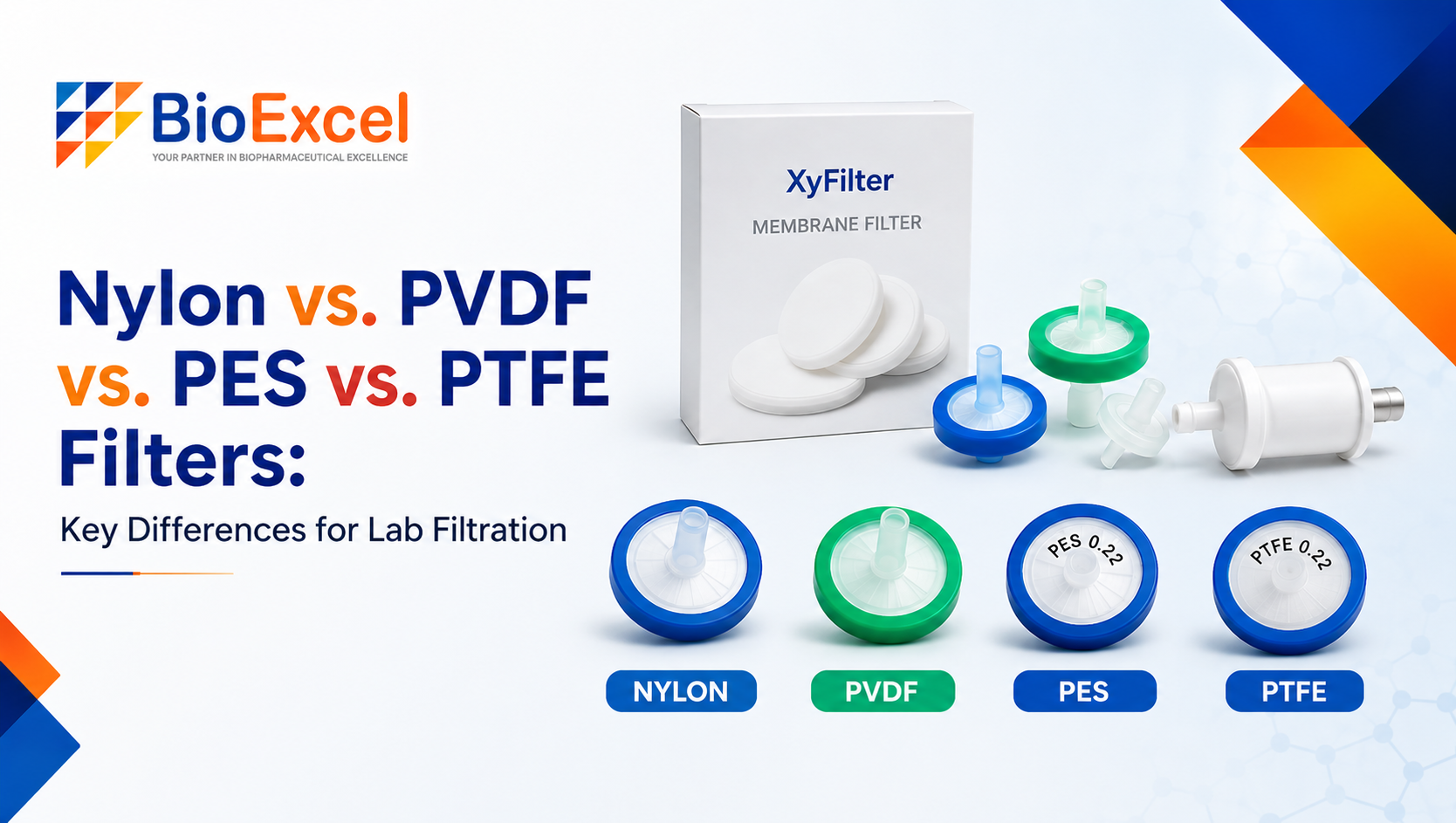
Why Membrane Selection Matters: Beyond Simple Particulate Separation
The process of filtration in a laboratory does not only concern the separation of particulates from samples. The kind of membrane to be used can have an effect on the precision of the analysis, sample recovery, protein adsorption, compatibility of the chemicals, and even the safety of the equipment.
From preparing HPLC samples to filtration of biological solutions and routine QC testing, understanding the benefits of nylon, PVDF, PES, and PTFE membranes is essential to ensure accurate results. BioExcel Pharma membrane filtration technology is customized to address the needs of the pharmaceutical industry, biotech industry, environmental science, and quality control laboratories due to its high level of performance and filtration.
Membrane filters have different physical and chemical properties depending on the type. Some of the elements that determine which filter to use include hydrophobicity, protein binding, solvent compatibility, and flow rate. Rather than relying on one membrane for every application, laboratories should select the membrane that best matches their sample chemistry and analytical method.
Membrane Comparison at a Glance
The variation in hydrophilic nature, chemical resistance, and protein adsorption makes certain membranes more appropriate for specific laboratory procedures. Below is a detailed breakdown of core operational properties:
| Property | Nylon | PVDF | PES | PTFE |
|---|---|---|---|---|
| Hydrophilic | Yes | Yes (Hydrophilic grade) | Yes | No (Hydrophobic) |
| Organic Solvent Compatibility | Excellent | Excellent | Limited | Outstanding |
| Aqueous Solutions | Excellent | Excellent | Excellent | Requires pre-wetting |
| Protein Binding | Moderate | Low | Very Low | Low |
| Flow Rate | Good | Good | Very High | Moderate |
| Chemical Resistance | Good | Excellent | Moderate | Exceptional |
| HPLC Prep | Excellent | Excellent | Good | Excellent (Aggressive) |
| Biological Samples | Moderate | Excellent | Best Choice | Limited |
| QC Lab Testing | Excellent | Excellent | Excellent | Excellent (Solvents) |
Nylon Membrane Filters
Nylon membranes are among the most widely used filtration materials in pharmaceutical and analytical laboratories because of their broad compatibility with aqueous samples and many organic solvents.
Advantages: Strong mechanical durability, excellent compatibility with alcohols and common HPLC solvents, highly cost-effective for general laboratory use, and ideal for routine analytical filtration workflows.
Best Applications: HPLC sample preparation, dissolution testing, routine QC analysis, buffer filtration, and general cleanroom laboratory filtration.
Limitations: Nylon membranes exhibit moderate protein binding, making them less suitable for protein-sensitive biological samples. They are also not recommended for highly acidic solutions.
PVDF Membrane Filters
Polyvinylidene Fluoride (PVDF) membranes provide an excellent balance between chemical resistance and low protein adsorption, making them one of the most versatile filtration materials available.
Advantages: Low protein binding, broad chemical compatibility, low extractables, excellent mechanical strength, and available in both hydrophilic and hydrophobic versions.
Best Applications: Biological sample filtration, pharmaceutical sample preparation, protein solutions, sterile filtration, and sensitive HPLC/UHPLC sample preparation.
PVDF membranes are frequently selected when laboratories require high recovery of valuable proteins while maintaining strict chemical compatibility with aggressive analytical solvents.
PES Membrane Filters
Polyethersulfone (PES) membranes are recognized for their exceptionally high flow rates and extremely low protein binding dynamics.
These characteristics make PES the preferred choice for biotechnology and pharmaceutical laboratories handling precious biological samples where material loss must be strictly avoided.
Advantages: Fast filtration throughput, very low protein adsorption, reduced operational filtration time, and high overall sample recovery margins.
Best Applications: Cell culture media preparation, vaccine filtration, biological sample processing, microbiology laboratories, and sterile aqueous filtration runs. Because of their superior flow performance, PES membranes directly improve productivity in laboratories processing large volumes.
PTFE Membrane Filters
PTFE (Polytetrafluoroethylene) membranes offer the highest level of chemical resistance among common laboratory filtration materials.
Their inherently hydrophobic nature makes them ideal for organic solvents, aggressive chemicals, air filtration, and continuous gas venting configurations.
Advantages: Outstanding solvent compatibility, highly resistant to strong acids and bases, excellent thermal stability, and extremely low extractable profiles.
Best Applications: Organic solvent filtration, gas purification, vent filtration, aggressive chemical analysis, and environmental testing. For aqueous samples, standard hydrophobic PTFE membranes generally require analytical pre-wetting or the implementation of explicit hydrophilic PTFE variants.
Choosing the Right Membrane for HPLC Sample Preparation
HPLC systems demand completely particle-free samples to prevent column blockage, minimize system downtime, and maintain strict analytical precision over long processing queues.
- Nylon: Excellent for routine HPLC solvents and general everyday analytical sample preparation.
- PVDF: Ideal for protein-containing solutions or sensitive pharmaceutical sample matrices.
- PTFE: The absolute best choice for aggressive organic solvents and corrosive mobile phases.
- PES: Highly suitable for aqueous biological samples requiring minimal protein loss.
Selecting the appropriate membrane significantly improves overall chromatographic performance while extending analytical column operational life.
Best Membranes for Biological Sample Filtration
When filtering proteins, enzymes, antibodies, or cell culture media, minimizing analyte adsorption at the membrane boundary layer is critical to saving costs and protecting yield.
PES stands out as the primary choice due to its lowest overall protein binding, highest sample recovery profiles, and exceptional flow rates. PVDF follows closely behind, offering low protein adsorption parameters combined with suitability for sterile pharmaceutical applications and excellent multi-solvent resistance. These membranes preserve valuable biological molecules while maintaining complete filtration efficiency.
Membrane Selection for Routine QC Laboratories
Quality Control laboratories often process highly diverse sample types throughout the day. To maintain complete analytical consistency across different compendial testing methods, general guidelines include:
- Utilizing Nylon for routine analytical testing and standard aqueous validation runs.
- Implementing PVDF for complex pharmaceutical formulations and multi-component drugs.
- Deploying PES for clean biological and microbiology media testing loops.
- Reserving PTFE for solvent-heavy chemical analysis, gas venting, and strong acid matrices.
BioExcel Pharma supplies top-notch membrane filter technologies including Nylon, PVDF, PES, and PTFE varieties, manufactured to global compliance standards for precise lab diagnostics.
Frequently Asked Questions
Optimizing Analytical Precision in Lab Filtration
Not all membranes are ideal for every single use in the lab. Successful workflows depend heavily on the nature of the sample matrix, solvents used, requirements to recover rare proteins, and expected flow rate performance.
When it comes to laboratories deeply engaged in commercial pharmaceutical production, biotech research, HPLC testing, and general quality control, choosing the correct membrane configuration will definitely help increase data precision, protect valuable instrumentation, and optimize routine laboratory workflows.
Explore the full portfolio of high-performance filtration consumables at BioExcel Pharma to align your laboratory architecture with globally verified benchmarks.