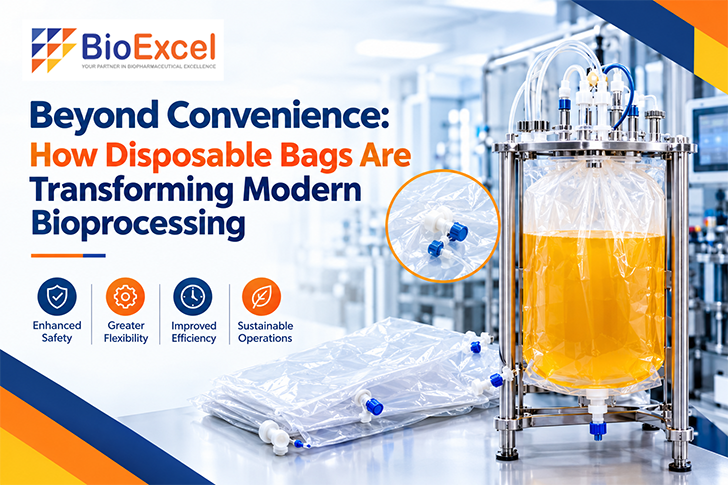
Biopharmaceutical manufacturing is becoming more flexible, faster, and focused on contamination control. As processes move from development to commercial production, manufacturers are looking for solutions that simplify operations without compromising sterility or reliability. This is where single-use bioprocess bags have moved beyond convenience to become an important part of bioprocessing.
Disposable bags are used for fluid storage, mixing, sampling, cell culture, buffer preparation, and transfer. Their growing adoption reflects a shift toward flexible manufacturing that can respond to changing batch sizes and production requirements.
What are Disposable Bioprocess Bags?
Disposable bioprocess bags are sterilised bags that are meant to hold process fluids and biological substances in a controlled environment. The setup can be made into either 2D or 3D bags and may include elements such as tubing, connectors, ports, filters, etc.
While these are not like the usual stainless-steel vessels which remain in use for multiple processes, the idea behind using disposable bags is the reduction in cleaning and sterilising procedures between batches.
For companies making biopharmaceutical products, the importance of a disposable bag goes beyond just its disposability.
Why Are Disposable Bags Gaining Ground?
A major issue in bioprocessing is maintaining sterility in the process while controlling the production schedule. The traditional processing equipment may require considerable time to clean and prepare for the subsequent batch, but single-use processing technology can reduce this because the product-contact parts are available for use post sterilization and quality testing.
This can help manufacturers:
- Reduce cleaning and sterilisation requirements
- Support faster batch changeovers
- Minimise potential cross-contamination between campaigns
- Adapt production areas to different batch sizes
- Reduce dependence on fixed process infrastructure
These advantages are useful for facilities handling multiple products where flexibility matters.
Supporting Fluid Handling Across the Process
Fluid movement is an essential process in biopharmaceutical manufacturing. The buffers, media, intermediates, water, harvests, and other process fluids will require storage, mixing, sampling, and transfer at various stages.
Today's sterile fluid transfer bags provide the solution for all these processes to be done under controlled conditions. According to the type of bag, some of the accessories that can be provided include connector ports, tubing, and sample ports.
Storage bags can also provide an option when materials need to be held temporarily before the next processing step. This can reduce unnecessary transfers between rigid containers.
Flexibility from Development to Production
Not all bioprocessing happens linearly. Formulations get altered; batches get bigger, and production needs change while products progress from development to commercialisation.
Here lies the flexibility advantage of single-use systems. The manufacturer can choose to use bags of different sizes and designs depending on process needs rather than designing processes around fixed equipment.
Smaller bags may support development and sampling activities, while larger systems can be used for mixing, storage, or process transfer. BioExcel Pharma’s XyBio portfolio includes solutions for cell culture, storage, freeze-thaw, sampling, mixing, and bioreactor applications.
Quality and Material Considerations Matter
Disposable does not mean simple. In regulated bioprocessing, the bag’s materials, manufacturing environment, sterilization method, integrity, and documentation all matter.
Manufacturers typically need to consider chemical compatibility, extractables and leachables, sterility assurance, pressure resistance, connection integrity, and traceability. The right configuration depends on the process fluid, temperature, contact time, volume, and application.
For this reason, choosing a Disposable Bag Manufacturer in USA should involve more than comparing bag sizes or prices. Technical documentation, product consistency, quality controls, customisation options, and supply reliability should also be considered.
The Bigger Shift in Bioprocessing
This shift towards disposable bags is a part of an even broader trend in pharmaceutical production. Manufacturers must work in an efficient manner while being able to adapt to new treatments and production runs.
The use of disposable technology will facilitate this adaptation while not requiring all process steps to be built on dedicated equipment. This technology does not replace good process design and control, yet it allows efficient process execution.
Conclusion: Building More Flexible Bioprocesses
Disposables are not regarded as convenient containers anymore. Usage of disposables in storage, mixing, transportation, sampling, and cell cultivation demonstrates how the use of single-use technology is able to contribute to flexible and productive bioprocessing process flows. BioExcel Pharma offers sterile XyBio bioprocess bags and assemblies for different pharmaceutical purposes.