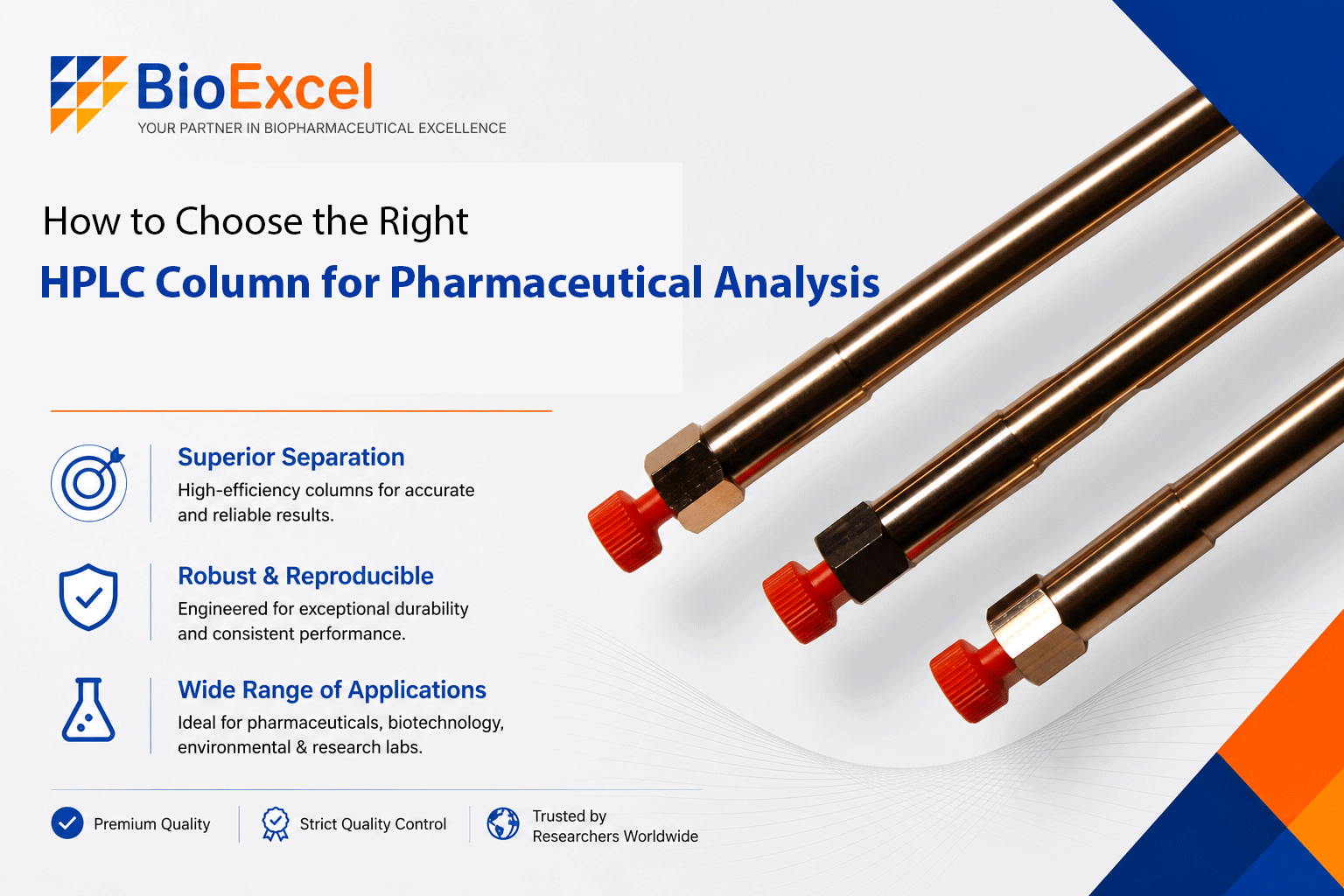
HPLC is one of the most important methods used across all stages of drug development – R&D, quality control, formulation development, impurity profiling, and routine testing. Nevertheless, even an optimised HPLC method will not give consistent results when an inappropriate HPLC column is used for analysis. The choice of column affects all aspects of the HPLC method, including retention, resolution, and peak shape, pressure, and method performance in general.
In the case of laboratories dealing with API, excipients, final products, and mixtures, the choice of HPLC column should not only be based on the common C18 column. It is necessary to take into account some details about column chemistry, dimensions, particle size, pore size, and sample properties.
Start with the Analytical Requirement
Before selecting an HPLC column for pharmaceutical analysis, clearly define what the method needs to accomplish. Are you performing assay testing, impurity analysis, dissolution testing, stability studies, or identification? The required resolution and retention can vary significantly between applications.
For routine QC testing, a robust and reproducible column may be more important than achieving extremely high theoretical efficiency. For impurity profiling, however, stronger separation between closely related compounds may be essential.
The sample itself also matters. Consider molecular size, polarity, ionisation, concentration, matrix complexity, and the chemical properties of the analytes before selecting the stationary phase.
Understand Column Chemistry
Column chemistry determines how analytes interact with the stationary phase and is one of the most important factors in pharmaceutical HPLC column selection.
C18 chemistry is the most commonly used reversed-phase chemistry due to the high hydrophobic interaction capability and wide compatibility with pharmaceutical compounds. C8 chemistry has relatively low hydrophobic interaction capability and may be used when rapid elution is necessary.
Other phases can provide alternative selectivity when C18 does not deliver adequate separation. Phenyl and biphenyl phases can improve selectivity for aromatic or structurally similar compounds, while CN, NH2, ion-exchange, and silica phases serve specific analytical requirements. BioExcel Pharma's chromatography range includes C18, C8, phenyl, biphenyl, CN, NH2, SCX, SAX, and other stationary phases for different separation needs.
Choose the Appropriate Particle Size
Particle size directly affects column efficiency and system pressure. Smaller particles generally provide higher efficiency and improved resolution because they offer more efficient mass transfer. However, they can also create greater backpressure.
For conventional HPLC methods, 3–5 µm particles are commonly considered practical choices. Smaller particles can be beneficial for high-efficiency separations and UHPLC applications, provided the instrument can safely handle the resulting pressure.
The objective is not simply to choose the smallest available particle. Select a particle size that balances resolution, analysis time, pressure, and instrument capability.
Consider Pore Size for Your Sample
The importance of pore size increases when you are dealing with large molecules. Small molecule pharmaceutical analysis uses regular pore sizes, but in case of peptides, proteins, and other biomolecules, you need pore sizes that are larger.
An inappropriate pore size for your molecule may limit its accessibility to the stationary phase. Therefore, in choosing HPLC columns for pharmaceutical analysis, keep in mind both chemistry and molecular size.
Select the Right Column Dimensions
Column length, internal diameter, and particle size work together to determine separation efficiency, solvent consumption, analysis time, and pressure.
Longer columns can provide greater resolution but may increase run time and pressure. Shorter columns can support faster analysis when adequate separation can still be achieved. Narrower internal diameters reduce solvent consumption, while larger diameters may be useful for higher sample loads.
For routine pharmaceutical QC, the best choice is usually the column dimension that meets the required resolution without unnecessarily increasing cost, solvent use, or analysis time.
Match the Column to the Method
A column should always be compatible with the mobile phase, pH, temperature, organic solvents, sample matrix, and operating pressure specified by the method. If transferring an established method, maintaining equivalent stationary-phase characteristics is particularly important for reproducibility.
For challenging separations, changing column chemistry may provide better results than simply increasing column length. Similarly, if peaks are excessively retained, a less hydrophobic phase such as C8 may be worth evaluating.
Sample filtration and appropriate preparation should also be considered because particulates can affect chromatographic performance and shorten column life.
Application-Based Column Selection
A practical selection approach can be summarised as follows:
- Routine API or assay testing: Start with a robust C18 column.
- Highly retained hydrophobic compounds: Consider C18 with suitable dimensions or alternative selectivity.
- Faster pharmaceutical analysis: Evaluate C8 or shorter columns where resolution permits.
- Closely related impurities: Consider phenyl, biphenyl, or another selective phase.
- Peptides and proteins: Evaluate wide-pore or biomolecule-specific columns.
- Size-based separation: Consider size-exclusion chromatography.
- Highly polar or ionic compounds: Investigate suitable ion-exchange, HILIC, CN, or other specialised phases.
BioExcel Pharma offers chromatography solutions covering general-purpose C18 and C8 phases as well as biphenyl, C18-AQ, normal-phase silica, sugar, and size-exclusion options.
Frequently Asked Questions (FAQs)
Conclusion
Choosing the right HPLC column for pharmaceutical analysis is a balance between chemistry, sample characteristics, resolution, retention, pressure, dimensions, and instrument compatibility. Instead of selecting a column based only on popularity, analytical laboratories should evaluate the complete method and application requirements.
For dependable chromatography solutions, explore BioExcel Pharma's range of HPLC columns for pharmaceutical analysis and contact the team for support in identifying a suitable column for your QC, R&D, or analytical workflow.